Updates from LMHudson Toggle Comment Threads | Keyboard Shortcuts

  • Unknown's avatar

    LMHudson 1:56 pm on January 23, 2020 Permalink | Reply  

    GPLET forum January 13, 2020 

    GPLET (Government Property Lease Excise Tax) is a development tool authorized by the state. It requires the government to pick winners, and so offers the potential for misuse. In the mayoral forum on 13 December, Corey Woods argued that GPLETs are over-used and hurt the school districts’ ability to collect taxes. This forum was organized by Ron Tapscott of Tempe Neighbors Together (TNT). You can find TNT on Facebook. The speakers are Ken Jones, Tempe’s CFO, and Alex Smith, Deputy Community Development Director.

    The video (about 46 minutes) is here.

    The first 8 minutes explain the history and philosophy of the program, how it is grounded in state law, and how it works as an incentive to development. All taxes are rebated for 8 years. Private property can use program by selling and leasing back. After 20 minutes, the discussion veers off the subject of GPLETs. In the discussion afterward (not on the video), Corey Woods acknowledges that the program does not, in fact, hurt the schools and that the school districts probably misunderstand it.

    (7:55) Tempe Marketplace is a site that would not have been developed (in Jones’s opinion) without an incentive, because the site required remediation.

    (8:15) Arizona legislature corrects lack of inflation escalator, brings excise tax in line with ad valorem, so the subsidy henceforward is the 8 year rebate.

    (11:00) Tempe Buttes the original GPLET, on government land.

    (13:50) the difference between government land and ASU property, and why developments on ASU land (such as State Farm) will never pay tax.

    (15:45) how school districts are protected from loss of revenue.

    (17:30) Are the incentives really needed? Jones cites oversight by state, Goldwater Institute, other cities competing for development, as evidence the subsidy is not just given away.

    (20:10) the cost of the dam and its repair.

    (24:40) other development tools, such as sales tax rebates.

    (25:00) Urban Core presents different issues, such as building height. Jones and Smith defend the use of executive session (closed meetings).

    (29:30) hotel tax revenues are exceeding expectations.

    (30:05) how did the Tempe City for the Arts (TCA) get overshadowed by such big buildings? Who decides?

    (32:10) IDEA campus, west of the TCA, as example of remediation project.

    (34:00) further amendments to the TCA campus.

    (35:40) remediation expense caused plans to change.

    (36:30) opportunity zones, a federal development program.

    (40:30) Corey Woods asks why the city has so few development tools.

    (43:10) how the city follows up on promises made by developers.

    (45:20) in response to my hypothetical question about how an owner of a single family lot might use GPLET to build a multifamily development, Jones says the proposal would have to be approved under the zoning law.

     
  • Unknown's avatar

    LMHudson 3:11 pm on January 2, 2020 Permalink | Reply  

    Mayor Candidates’ Forum December 13 

    Youtube link is here.

    75 minutes. Much more informative than the city council video, perhaps because there are only two candidates, Mark Mitchell and Corey Woods, and they have more time to talk. There is also some well-mannered clash: the two candidates appear to like each other, but Woods would do some things differently and do more things. Both candidates seem to be knowledgeable about lots of programs and to believe that lots of programs is a good thing.

    Here is a map of the video. There are 14 questions. Comments are mine, based on listening only once. In their opening statements, starting at 4:23 Mitchell expresses pride in the equal pay and anti-discrimination ordinances, and at 5:30 Woods sees challenges in traffic, homelessness, and bulk trash.

    1. economic development (7:15) Woods would emphasize work force training and partner with small business and startups. He is against large companies who want to build tall towers. (9:05) Mitchell claims to have had a role in creating 33,000 jobs and $3 billion of investment. He is pleased that 5 of the top 10 financial firms in the country have a presence in Tempe. He cites 1 million square feet in the Discovery Campus.
    2. are tax breaks for development necessary? (11:10) Mitchell says yes, on a case-by-case basis (12:10) Woods says they are overused and the school districts suffer (14:10) Mitchell says the schools are always held harmless. (but how?)
    3. is there too much conflict with the state legislature? (16:05) Woods promises to work harder with the legislators (17:00) Mitchell says he is (was?) president of the Arizona League of Cities and Town, which–my comment– is a chronic opponent of the legislature (18:25) Woods cites the short-term rental issue as something that should have been resolved (19:35) Mitchell claims to have had a role in getting a working group started on that issue in the legislature.
    4. what do you regret? (20:50) Mitchell has no regrets (21:50) Woods regrets voting for the Hayden Flour Mill project, even though his vote would not have made a difference, because he was skeptical and the project is so far been a failure.
    5. this question, from the audience, about a relationship between a former council member and a developer that caused the member to recuse herself seemed inapt (24:05) Both candidates insist nothing unethical happened.
    6. climate change (27:30) Mitchell says Tempe is the 17th most bicycle-friendly city in the country, and that Tempe residents have the highest ridership on light rail in the Valley (29:15) Woods says he does not understand why the issue of a bike lane on McClintock Dr has not been resolved. He would expand the street car program. He understands why light rail is under-utilized: it doesn’t go where people want to go.
    7. alleged police misbehavior (32:10) Woods says people need a forum for expressing themselves that is not so agenda-bound as the City Council (33:40) Mitchell says he is always ready to listen.
    8. after the departure of Childsplay from the TCA, how can the TCA be better utilized? (35:05) Mitchell says the new boss, Ralph Remington, is bringing in great programs. He says the city is requiring new development to include public art (36:20) Woods says the TCA’s main theater is too small so its booking strategy must change. He would like to see a kitchen installed in the TCA bar.
    9. climate change (38:30) Mitchell says city is working with SRP to plant more trees, aims to be carbon neutral by 2035 (39:50) Woods wants to ask new development to be more sustainable, to include solar panels, rain-water harvest equipment. He also likes trees.
    10. an audience member expresses concern about 500 new parking places on the southwest corner of Broadway, adjacent to a single family residential neighborhood (43:25) Woods cites limits to development in the Vision Zero program. He notes that the Urban Core Master Plan does not yet deal with traffic issues. (45:20 Mitchell says the parking places approved were less than those proposed. He is concerned about density and supports Vision Zero. (47:55) Woods says the North Tempe Neighborhood Association wants development, so the congestion can be spread out.
    11. homelessness (49:20) Woods says more housing will alleviate permanent camps in Papago Park and aggressive pan-handling on Mill. The Housing First program has been imitated around the Valley (51:30) Mitchell cites Tempe’s Agency Review program, claims Tempe spends 32% more on human services than other Valley cities. He claims to have housed 3,000 ‘individuals and families’ in partnership with programs like Housing First, New Town, Habitat for Humanity, Eastline Village, and the Community Land Trust. (53:50) Woods says Mitchell’s 32% includes money from HUD.
    12. policing (56:00) Mitchell cites My Brother’s Keeper program (57:00) Woods calls for more, better communication
    13. is South Tempe neglected? (58:40) Mitchell cites Character Areas, the Discovery Campus where Chase has 4,500 employees. (1:00:07) Woods thinks what South Tempe residents want are lifestyle amenities. He will revitalize strip malls, to encourage more shopping in Tempe. Rural & Warner was a food desert until Tempe Public Market et al were started. He would re-use old buildings. He cites the Village Planning Committee. (1:03:20) Mitchell cites small business, such as Voodoo Daddy’s Steam Kitchen.
    14. is there too much development? (1:06:45) Woods says voters must approve development plan every 10 years by a super-majority. Speculators want to build tall towers. (1:08:05) Mitchell notes Tempe is land-locked but must grow somehow (1:09:10) Woods says the city does not adequately protect neighborhoods (1:10:30) Mitchell cites denial of permit to proposed tire shop at Warner & McClintock because neighbors protested.
     
  • Unknown's avatar

    LMHudson 11:07 am on January 2, 2020 Permalink | Reply  

    City Council Candidates’ Forum December 13 

    Youtube link is here.

    One hour 25 minutes. Most of the questions were good but there were too many and the candidates barely had time to respond. Four candidates appear: Casey Clowes, Doreen Garlid, Randy Keating and Joel Navarro. Marc Norman was absent. Most of the questions came from representatives of the sponsors of the forum, Jihann Cottrell, president of the Tempe Chamber of Commerce, and Paulina Pineda, who covers Tempe and Chandler for the Arizona Republic.

    The questioners and the candidates all shared the premise that city government can and should do anything and everything: solve the homelessness problem, provide affordable housing, battle against climate change, provide pre-school, and grow Tempe’s economy. There is no clash. The candidates are all civil and friendly to one another. The new candidates, Clowes and Garlid, do not attempt to make a case why they would be better than the incumbents. Clowes emphasizes human services and what she calls environmental justice. Garlid emphasizes her considerable experience on various community action boards.

    To each of 16 questions, each candidate had 60 seconds to respond. Here is a map of the questions, at roughly 4 minute intervals. Comments are mine, based on listening only once:

    1. traffic congestion (9:12) Most have ideas like spreading out growth, or building parking on the periphery. Clowes wants to discourage private cars.
    2. high rent (12:57) Clowes favors more multi-family housing.
    3. term limits (17:38) Clowes favors; the others don’t.
    4. short-term rentals effect on neighborhoods (21:49) Navarro favors 24-hour code enforcement. Garlid supports Isela Blanc’s HB2001, which would repeal SB1350.
    5. tiered charging system for residential water use (25:43)
    6. preservation of downtown (31:03)
    7. budget priorities (35:50) Navarro and Garlid favor infrastructure, roads and safety; Clowes and Keating human services
    8. transparency (41:05) Everyone is for it except Keating who says working groups need confidentiality
    9. should there be more Section 8 housing? (45:52)
    10. do you support renewal of Indian gaming grants? (50:25)
    11. economic development goals (54:30)
    12. should sales tax be increased to fund pre-kindergarten schooling? (58:50) Clowes says yes; others prefer grants. No one mentions the district schools.
    13. climate change (1:03:20) Clowes seeks environmental justice.
    14. help small business? (1:07:25)
    15. homelessness (1:12:40) Keating says this is a regional problem.
    16. are taxes too high? (1:18:20) All say no. Keating and Garlid cite recent passage of Arts tax (Prop 417) as evidence taxes are not too high.

     
  • Unknown's avatar

    LMHudson 6:47 pm on December 30, 2019 Permalink | Reply  

    A proposal for voting in the March 2020 Tempe election: Don’t vote 

    For many years, Tempe has chosen to elect its sole branch of government on dates when turn-out is likely to be low. The main advantage of this may be to make it easier for candidates representing special interests — such as beneficiaries of any city program– to win. In the last ten years, the average number of ballots cast in mayor/city council elections is about 20,000. Over the same period, November elections (which are normally about amendments to the city charter and bond issues) average about 55,000 votes cast. (There are about 85,000 registered voters in Tempe.) Mark Mitchell was last elected mayor with just over 15,000 votes, and Lauren Kuby was last elected to the city council with less than 13,000 votes. All these results can be seen here.

    The state legislature tried to stop this in 2012 with a law (ARS 16-204) requiring charter cities (Tempe was not the only abuser) to hold their elections in even-numbered years in November at the same time as state-wide elections. Tucson successfully challenged this law at the Arizona Court of Appeals in 2014, arguing that the law violated the home rule provisions of the state constitution. (Opinion here.)

    The legislature accordingly amended the law (which is now ARS 16-204.01). The amended text is here. The amended law imposes a test: if the turnout in an off-cycle election is less than 75% of the turnout in November elections, the city must start holding their elections in November. If past elections are any guide, Tempe will easily fail that test in March but I will seriously consider not adding my ballot to the count. The obstacles to any conservative are formidable. He or she must advocate dismantling programs that cost everyone a little but provide benefits to a motivated few. Many of the programs are funded by grants, so the cost is even more diffuse, falling on Tempe voters only via their state and federal income tax obligations. It would, though, be harder to assemble a majority of 55,000 from the beneficiaries of city programs than a majority of 20,000.

    Who might one vote for, anyway? All of the candidates in the December 13 Forum competed with each other to promise yet more city programs: affordable housing, sustainability, and human services. You might wish to attend the Candidates Forum on February 3. (5:30pm at the Arizona Community Church 9325 S Rural Rd.)

     
  • Unknown's avatar

    LMHudson 2:36 pm on September 17, 2019 Permalink | Reply  

    8 studies in Municipal Courts 

    There is no separation of powers in our city government. The city manager, the police, and the judges are all employees of the city. The Council is the sole branch of government. The job of the judges is to collect fines. An attempt to subject them to an occasional retention election failed in the state legislature in the last session.

    Here are eight stories of people caught up in the municipal court system: https://goldwaterinstitute.org/citycourt/ They will frighten you, and give you reason to support the state legislature’s efforts to reform municipal government.

    City Court: Money, Pressure and Politics Make it Tough to Beat the Rap link: https://goldwaterinstitute.org/article/city-court-money-pressure-and-politics-make-it-tough-to-beat-the-rap/

    Unlike other Arizona judges, municipal court judges never face voters. They work for City Hall and their job is to collect fines and the associated court costs. They serve two year terms, renewable at the pleasure of the City Council. The rapacity of the municipal court of Ferguson, Missouri, where fines contributed about a quarter of the city budget, probably contributed to the riots in 2014. Half of all court cases in Arizona are heard in municipal courts. Misdemeanors can be criminal, such as violating smoking ordinances in Mesa. Municipal courts can impose up to six months jail time and $2,500 in fines (but court costs can boost the bill). A criminal misdemeanor conviction in a municipal court means a criminal record. The conviction rate for speeding tickets (not a criminal misdemeanor) is 88%. Suspending driving licenses is the only tool municipal courts have for enforcing fines. Pedestrian or bicycling misdemeanors can result in suspended driving licenses. Driving on a suspended license is a crime. Trial is before a judge with no jury. Arresting officer testifies, defendants give their side. Maricopa County rarely overturns a verdict.
    Tempe, along with Scottsdale, Gilbert, and Tucson, appear to run profitable courts. Two municipal court judges have been disbarred by the Arizona Supreme Court, one of them from Tempe.

    Prosecutors Push Jail for Disabled Vietnam Veteran over Zoning Violations link: https://goldwaterinstitute.org/article/prosecutors-push-jail-for-disabled-vietnam-veteran-over-zoning-violations/

    Robert Stapleton wouldn’t sell his home to developers (Paul Johnson, former mayor of Phoenix and friend of Scottsdale mayor Phil Gordon) and he got six criminal charges for zoning violations (5′ fence,weeds in his yard, fading paint, failing to park vehicles on a dust-free surface), each threatening 6 months in jail and $2,500 in fines. Convicted in Phoenix Municipal Court: probation for 3 years and a $15,000 fine. Johnson meanwhile got permission for a 6′ fence around his development. Jury trials not available for civil citations or for criminal when the maximum sentence is 6 months, despite guarantees in both US and AZ constitutions.

    Elections Protect Judges From “Good-Old-Boy” System Of Appointment link: https://goldwaterinstitute.org/article/city-court-elections-protect-judges-from-good-old-boy-system-of-appointment/

    Yuma is the only city in AZ where municipal judges are elected. Merit selection means a commission prepares a list of qualified candidates and the governor chooses. Then they face retention elections. Competitive elections require judge to raise money and campaign.

    ‘Outrageous’ Police Conduct Not A Concern For Scottsdale Judge link: https://goldwaterinstitute.org/article/city-court-outrageous-police-conduct-not-a-concern-for-scottsdale-judge/

    Scottsdale police regularly used the parking lot of Randon Miller’s Sushi Brokers restaurant to question and arrest drivers. Randon objected, saying they blocked access to his parking and that it was bad for business. Scottsdale police retaliated by setting up a sting on Miller. They made a fake traffic stop in front of his restaurant, hoping he would react. He did, and was arrested and charged with 9 criminal misdemeanor counts. A year later, the police staged a fake liquor inspection. Miller was not on duty and referred them to his manager. The police persisted in questioning him, he objected and they arrested him again. The stings were disclosed to the municipal court but the judge sentenced Miller anyway, to 10 days in jail, and a $2,250 fine plus court costs. Miller appealed, but Maricopa Superior Court upheld his conviction.

    Judges Believe Police Claims and Ignore Video Proof link: https://goldwaterinstitute.org/article/city-court-judges-believe-police-claims-and-ignore-video-proof/

    Municipal judges accept police testimony even when contradicted by video evidence. To protect the city from civil liability, it is essential that the police victim be convicted of some charge, such as disorderly conduct or resisting arrest.

    Shaky Cases Still Get ‘Rubber Stamp’ Convictions in Traffic Court link: https://goldwaterinstitute.org/article/city-court-shaky-cases-still-get-rubber-stamp-convictions-in-traffic-court/

    Appeals by the defendant are rare because it is always cheaper just to pay the fine, but successful appeals are even rarer. The judges must fail to do their job.

    Arizona Cities Continue to Prosecute People Under Illegal Statute link: https://goldwaterinstitute.org/article/city-court-arizona-cities-continue-to-prosecute-people-under-illegal-statute/

    ARS 28-1595(C) required passengers, pedestrians and bystanders to produce ID if the arresting officer had reasonable cause to believe they were involved in a traffic crime. The Arizona Court of Appeals ruled that law unconstitutional in 2003. Nevertheless, Tempe police used that law to arrest a bicyclist in 2011. (Tempe later paid him $20,000 in compensation.) Scott DeMars was convicted under the law by a Mesa municipal judge in 2016. It is probable that the conviction was designed to stop him from filing a lawsuit, as a conviction makes it hard to find a lawyer or to collect civil damages.

    Misdemeanor Convictions Lead to Lifelong, ‘Beyond Horrific’ Consequences link: https://goldwaterinstitute.org/article/city-court-misdemeanor-consequences/

    Scottsdale police again set up a sting, this time against a massage therapist. She was accused of offering sex for money but there was no evidence, only her word against the arresting officer’s. Scottsdale municipal court convicted her, anyway. The criminal conviction forced her to drop out of her nursing program and to give up her license as a massage therapist. She now cleans houses. Lake Havasu City municipal court issued a restraining order in a custody dispute which was itself a violation of an interstate compact, but it nevertheless proved a nightmare to the father. A Scottsdale judge placed a restraining order on a member of an HOA that effectively forced her to sell.

     
  • Unknown's avatar

    LMHudson 12:07 pm on September 17, 2019 Permalink | Reply  

    Short-term rental meeting Tuesday September 16, 2019 

    The City of Tempe hosted a meeting last night for all those concerned about short-term rentals. About 70 attended, in the Pyle Center. The principal speaker was Lauren Kuby, vice-mayor. She said that SB1350 “took away” Tempe’s authority to regulate short-term rentals and the purpose of the meeting was to solicit feedback as the city harmonizes its enforcement policy with state law.

    State law is a work in progress. SB1350 was amended in the last session to require owners of short-term rental properties to make themselves contactable. In the current session, HB2672, which further regulates short-term rentals, has passed the House.

    Feedback was of two types: Five or six people spoke about how their neighborhoods are being ruined by short-term rentals. They complained of traffic, illegal parking, noise, and public drunkenness. They said they complained repeatedly to the city authorities and were always told there was nothing the city could do. An equal number of people spoke as either owners or managers of short-term rentals. Three of them reside in their rental properties and rent out spare bedrooms. They argued that responsible short-term renting does not create problems in the neighborhood.

    Some interesting things were asserted in the ensuing discussion: (1) although Transaction Privilege Tax (TPT) disks are not yet required by the city, Airbnb and VRBO require them of their landlords; (2) one landlord asserts that the business is very hard, and that, in his opinion, many of the current crop of landlords will fail, and that no landlord has a chance unless they rent through Airbnb or VRBO; and (3) there is a technology available that permits landlords to count the number of WiFi connections in their rentals, presumably as a proxy for the number of residents.

    A state representative, Isela Blanc, who represents LD-26, spoke in favor of HB2672. She also claimed that the short-term rental problem is somehow related to the “lack of affordable housing,” but she did not explain how. Two officials from the Tempe Community Development Department said that they have no power to deny planning permission to multi-family housing proposed in single-family neighborhoods.

    There was little response to the city’s claim that it is powerless. I asked why the city has chosen not to enforce its consanguinity ordinance. Ms Kuby said there is “federal case law” that might make that ordinance difficult to enforce. She promised me exact citations, which I will publish here when I get them.

    Here is the city’s own report of the meeting, by Elizabeth Higgins to the Council, on 19 September: https://www.youtube.com/watch?v=IPYoOYctvvs The relevant part of the meeting begins at 2:17:30 and lasts 13 minutes. I believe they agreed to continue doing nothing for six months.

    It is possible to read and understand SB1350 (now ARS 9-500.39), linked here: https://www.azleg.gov/viewdocument/?docName=https://www.azleg.gov/ars/9/00500-39.htm

    The first paragraph directs cities not to discriminate against short-term rentals, but the paragraph immediately following requires them to protect the public’s health and safety, i.e. enforce city zoning ordinances. The claim that SB1350 has rendered cities powerless is untrue.

    We must speculate why Tempe claims it is without authority. Certainly Tempe is not historically shy when it opposes state law. The state has for many years tried to get cities to hold their elections in November, when the turnout is many times greater than the turnout experienced in off-cycle elections. Tempe’s next election for City Council is scheduled for the spring of 2020. Ms Kuby’s claim that “federal case law” prohibits enforcement of Tempe’s consanguinity ordinance is ironic for anyone who remembers her presentation, also at the Pyle Center, on the need for a city ordinance to outlaw “dark money.” A member of the audience asked if there were any jurisprudence on the subject of dark money, and either Ms Kuby or her deputy (I don’t remember) replied, “there is none.” A better answer might have been the 1958 US Supreme Court holding in NAACP v Alabama, where the court ruled that Alabama had no right to force the NAACP to disclose its donors. The city finds federal case law when it needs it. The state has a law which largely prohibits Tempe’s dark money ordinance.

    I know of no better explanation for Tempe’s policy than the City Council’s hostility toward low-density housing. Every presentation about the Urban Core plan always begins with the admission that mass transit has failed in Tempe and, therefore, all city planning must encourage greater population density.

    Here is a link to Representative John Kavanagh’s video about his bill HB2672: https://www.youtube.com/watch?v=9EWznhBAPgU&feature=youtu.be

     
  • Unknown's avatar

    LMHudson 11:46 pm on August 28, 2019 Permalink | Reply  

    Support school choice at no cost to you. Use the Arizona Tax Credit. 

    The Arizona Tax Credit gives all Arizona taxpayers a way of supporting school choice at no cost to you. School choice is intended to ensure that no families are trapped in the district school monopoly.

    My friend Lou Bates, who is a tax professional, thinks what I wrote below is perhaps too much information for those who do not do their own taxes. Her one paragraph explanation follows. What follows that is aimed at those who do their own taxes, or at least wish to understand what their tax preparer is doing.

    Evading taxes is illegal but avoiding taxes is legal and, in Arizona, encouraged by law. Single people can avoid paying the state up to $1,655 per year in income taxes, twice that amount if married filing a joint return. There are four Arizona charity categories to which you can contribute specific amounts every year and not pay the State of Arizona that amount – legally. The contributions can be made by the filing due date of your return – usually April 15 – and deducted on the previous year’s return. The charities are mostly child related such as Public Schools, Private Schools and Foster Care. The other recipients are general charity organizations. The list of acceptable organizations is available on the Arizona Department of Revenue (AZ DOR) and includes codes that are required on the tax return. Additionally, most tax preparers can assist you with the necessary info. — Lou Bates

    If you pay Arizona income tax, you can simply direct that money to certain charities, including schools. You make a donation to a school that you wish to support and you get a credit for the amount of your donation against your Arizona tax liability. There are rules and limits, and, like any charitable donation, it is up to you to make sure the school receiving your donation is worthy of it.

    You may support both public and private schools. Public (including charter) schools must use your donation on certain activities, such as extracurricular, or on instruction designed to build character. Private school tuition organizations (STOs) give scholarships to students attending private schools, including Catholic and Montessori schools. You can recommend both the school and the student to receive the scholarship, but your recommendations are not binding on the STO.

    Each donation requires its own form in your tax return. Your donations are summarized on form 301, whose last line gets carried to line 51 of form 140 (“Nonrefundable Credits from Arizona Form 301, Part 2, line 69”) which is a full credit to your tax liability. “Nonrefundable” means that the credit is limited to your tax liability. You will need forms 322, 323, and perhaps 348. (See Appendix 2 below for examples.)

    There are two other tax credit programs available, for Qualifying Charitable Organizations and Qualifying Foster Care Organizations. Please use them. I do not discuss them here because they are outside my topic of school choice.

    In 2018, the limits on this gift were:

    filer:individualjoint
    public school200400
    STO1,1102,213
    total available credit1,3102,613

    You may make your gifts as late as April 15 for the prior calendar year, so you will be out the cash only in the case where you are owed a refund, and then for only as long as it takes Arizona to process your return. You can give to a district public school in Kyrene School District. Most schools will let you specify a use, so you can support the ROTC program at Corona. (See Appendix 1 below for instructions.) You can give to a school that is in another part of Arizona. Any taxpayer can give. You are not required to have children.

    Here is a link to eligible public (including charter) schools: https://azdor.gov/sites/default/files/media/PUBLICATION_ADESchoolListing.pdf.

    Here is a link to eligible STOs: https://azdor.gov/sites/default/files/REPORTS_CREDITS_2018_fy2017-private-school-tuition-org-credit-report.pdf

    In 2017, there were about 2 million income-tax-paying households in Arizona. Only 15% used the Tax Credit for public schools (average gift $169). Link. Only 4% used the Credit for STOs (average gift $1,200).

    As of this writing, I have not been able to find good numbers that might help further describe the need to support school choice. Statewide, American Community Survey data show that, in 2018, only 12% of primary and secondary school students attended a private school. Of those students in public schools, only 17% attended a charter school. In Tempe, which is served by Tempe Preparatory Academy, the Great Heart schools, and the BASIS schools, and others, –not all of which are physically in Tempe–there is competition for students. Not all parents would consider a charter school. (There is no bus.) It may take some years for more parents to become disillusioned by the district schools.

    Appendix 1: instructions for giving to the ROTC program in Tempe Union High School District

    • browse to: https://az-tempeunion.intouchreceipting.com/
    • create an account
    • select “Items at all schools” then select “high school” then last “Marcos de Niza High School”, select “Tax Credit Donations”
    • Scroll down to “ROTC” and enter donation amount and click “buy,” then check out. You will get a receipt immediately.

    Appendix 2: filled examples of Arizona Tax Credit forms

    AZ301:

    AZ322:

    AZ323:

    AZ348:

     
  • Unknown's avatar

    LMHudson 11:22 pm on August 19, 2019 Permalink | Reply  

    Airbnb is coming to your neighborhood 

    In May, 2016, Governor Ducey signed SB1350 into law. The law prohibits municipalities from discriminating against people who wish to rent their home for short periods of time, as facilitated by services like airbnb.com. There is no requirement that any owner ever be present. It did not take long for abuse to begin.

    In March of 2017, a Nevada-based entrepreneur named Juan Pulido bought 8648 S Holbrook Lane in La Colina, then a 5 bedroom, 3,000 square foot home, for $420,000. He converted the home into a 10 room, five bath hotel. He subdivided the public rooms and installed lofts where there were high ceilings. Each bedroom has its own locked door. He paved the entire front yard to provide parking. Between April and September he submitted four separate planning applications to the City of Tempe Community Development Department for such projects as “New bathroom 2nd Floor”, “Bathroom Remodel, install 4 new doors,” “Adding internal 2nd Floor Structure and Bathroom,” and “Add new patio.” Tempe did not object to anything and gave Pulido a clean inspection at the end of the work.

    The neighbors objected to Pulido’s plans, to no avail. Here is a link to a City Council meeting on December 7 2017: https://www.youtube.com/watch?v=RX-VXsQ9IsM At the 3:09 point, you can see Kolby Granville speaking for 4 minutes on this subject, saying there may be nothing the city can do about it, because of SB1350. The neighbors across from Pulido sold their homes, for $444,000 in December 2017, and $336,400 in January 2019.

    Parking 1
    parking in front of 8648 S Holbrook Lane
    One of Pulido’s occasional clients arrives in an 18-wheeler. He comes late at night and parks every one else in.

    At this writing Pulido has 3 single male tenants, each paying him a rumored $1,200 a month. That’s about a 10% cash yield on his investment. Apparently there is a shortage of housing in Tempe for single males with bad credit. The Tempe City Council welcomed SB1350 in part because they perceive a shortage of accommodation for tourists. Right now the market says the highest and best use of single-family real estate is as short-term rental.

    There is a companion to SB1350, HB2333, defeated in the last session, which would permit home-owners to operate businesses from their premises, subject to health and safety regulations. It is intended to help people who run quiet businesses with few customers, but it will be abused as well.

    The Tempe City Council is conflicted. All members are elected at large, so none represent South Tempe, even though almost 60% of the voters live south of Southern Avenue. Elections are intentionally off-cycle, in order to reduce turn-out, which helps special interest groups to dominate the voting. In May, at a public meeting to discuss its “Urban Core Masterplan,” Tempe’s Principal Planner, Ambika Adhikari, introduced his remarks by admitting that, so far, mass transit has failed in Tempe. His proposed solution to support mass transit was to encourage increased population density. It is possible to imagine that the Council, which is our sole branch of government, is at best indifferent to low-density housing, and probably hostile.

    Neighborhood associations have almost no defense against the combination of profitable short-term rentals and the studied indifference of the city. HOAs have a better chance of protecting neighborhoods, but they are a very flawed mechanism. Most HOAs, though they theoretically have power to disapprove house plans, do nothing, hoping that the City Planning Department will protect them.

    There is a desultory effort under way to encourage Tempe to enforce its consanguinity laws, but most possible solutions are long-term, piecemeal, and will require lots of civic involvement. HOAs can, of course, fine the offenders, but resolution of disputes is normally handled through the court system, which is startlingly expensive and delivers justice only randomly. A local inexpensive system of arbitration is needed. Cities are theoretically under the control of the state, but a recent attempt to bring municipal judges under voter retention failed in the legislature, so the judges remain exclusively loyal to the city councils.

     
  • Unknown's avatar

    LMHudson 10:29 pm on August 19, 2019 Permalink | Reply  

    Want to vote early? Here’s how. 

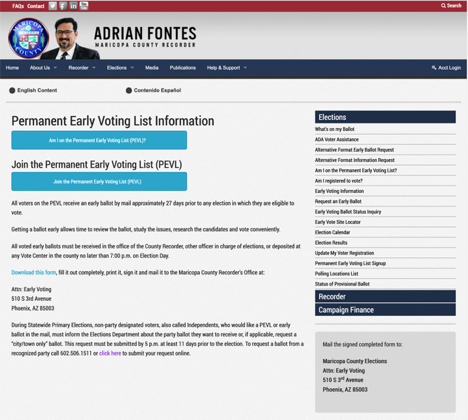
    About three-quarters of the voters in South Tempe vote using the Early Ballot and are on a list called Permanent Early Voting List (PEVL). If you don’t tick the right boxes at the DMV, you can find yourself unable to vote on Election Day and not know how to get an Early Ballot. Here is how to do it:

    Step 1: browse to https://recorhttps://recorder.maricopa.gov/earlyvotingballot/permanentevlistinfo.aspx which looks like this:

    Step 2: click on the second blue bar, labeled “Join the Permanent Early Voting List (PEVL)”. You will be presented with a downloadable form like this:

    Step 3: Fill it out and mail it to the address provided, Maricopa County Elections Attn: Early Voting 510 S 3rd Ave Phoenix AZ 85003.

     
c
Compose new post
j
Next post/Next comment
k
Previous post/Previous comment
r
Reply
e
Edit
o
Show/Hide comments
t
Go to top
l
Go to login
h
Show/Hide help
shift + esc
Cancel