Recent Updates Page 5 Toggle Comment Threads | Keyboard Shortcuts

  • Unknown's avatar

    LMHudson 3:03 pm on September 22, 2020 Permalink | Reply  

    Maricopa County Community College District At-Large 

    There are two candidates:

    1. Shelli Richardson Boggs, website, facebook page, and
    2. Linda Thor, incumbent, website, facebook page, blog,

    Notable differences:

    Boggs is endorsed by Andy Biggs and Debbie Lesko.

    Thor is endorsed by Greg Stanton and many people from higher education. She is a supporter of Mitzi Epstein.

     
  • Unknown's avatar

    LMHudson 1:33 pm on September 22, 2020 Permalink | Reply  

    An argument for voting ‘No’ on Prop 208 

    This is a proposal to raise the top rate of income tax in Arizona by 78% and devote the proceeds to education. Good summaries of the economic arguments are here and here. Very little of the proceeds will reach teachers, anyway, article here. The proceeds will be divided between the district and charter schools according to school population, but most of the money by far will go to the district schools. Most of us, even those without school-age children, are willing to pay for public education, but will the district schools use this money well?

    The Arizona Retirement System, its membership mostly teachers at district schools, is dramatically underfunded ($15.6 billion, according to this study by the Reason Foundation). None of the money will go there.

    The charter and private schools in our neighborhood have done a much better job re-opening this year than have the district schools. The problems that have had to be solved in order to re-open are the same for charter, private, and district schools, but the district schools have lagged. Their problem is their immensity.

    The school districts are enormous compared to the charter and private schools. The three school districts (Tempe Union, Chandler Unified, and Kyrene Elementary, together serving nearly 100,000 students) are all promising to open by Oct 13, if the COVID “metrics” behave. By contrast, Desert Gardens Montessori (enrollment 260, infant-through-grade 12) has been open since June for small children and since August 17 for the older kids. St Timothy’s Catholic school (K-8 and about the same size), has also been open since August 17. Our public charter schools, Tempe Prep (6-12, enrollment 430) and Chandler Prep (K-12, enrollment 725) both opened September 8.

    Most activities achieve economies of scale. One might expect the district schools to be able, for example, to buy cheaper textbooks by buying in quantity. Government activities seem not to enjoy economies of scale. The cost to educate a student in the three school districts is not significantly different from the cost in the much smaller charter schools:

    schoolgradesenrollmentcosts ($m)cost per student
    Chandler School DistrictK-1245,9994008,707
    Kyrene School DistrictK-816,68317410,407
    Tempe High School District9-1213,3121279,541
    Chandler PrepK-1272579,217
    Tempe Prep6-1243049,152
    (These numbers come from the schools’ regulatory reports for 2019, pre-COVID.)

    The price of a year at St Timothy’s Catholic school (K-8, enrollment 260) is $7,500. The smaller schools may actually be more efficient.

    A consequence of excessive size, particularly for government organizations, is paralyzed decision-making. Here is a video of the September 16 meeting of the Tempe Union High School governing board. At about the 31 minute mark (after a lengthy presentation of COVID metrics by zip code) you can see the superintendent trying to make a decision on behalf of the entire district. They are unable to consider the possibility of opening some schools earlier than others. At 47:50 president Hodge declares that it would be inequitable to allow students in the southern part of the district to return to school when northern students cannot. No member of the governing board ever moves to challenge that idea, or in any way to discuss how the re-opening process might be sped up.

    The effect of excessive size on curriculum is a subject worthy of a separate post, here. Who do you suppose is better educated, a graduate of St Tim’s or a graduate of Kyrene?

    Support quality education by voting ‘No’ on Proposition 208. And don’t forget to use the Arizona Tax Credit to support charter and private schools at no cost to you. (See neighboring post.)

     
  • Unknown's avatar

    LMHudson 1:32 pm on September 22, 2020 Permalink | Reply  

    An argument for voting against all ballot initiatives 

    Ballot propositions are designed to bypass the legislative process, to allow citizens to make law directly. Democracies tend to end in tyranny, so the founders of our republic favored separation of powers rather than democracy. Making positive law is supposed to be difficult, not something to be done whimsically. Ballot propositions undermine the separation of powers and lead to bad law.

    Laws passed by the legislature may be readily amended, but laws passed by initiative can only be amended by initiative. Arizona permits three kinds of citizen initiative, an amendment to the constitution, a statute, and a referendum. Rules here. The rules for getting a proposition on the ballot do not require any geographical distribution. The sponsor of a 2020 ballot statute, for example, can gather all 237,645 required signatures in downtown Phoenix. There are companies that collect signatures. They charge about $10 per signature. (Search for ‘paid petitioners’ or ‘Arizona Petition Partners.’) Two million dollars sounds like a lot of money, but it is evidently no serious bar to out-of-state interests who wish to make Arizona law. Here is a good account of the difficulty of amending the statutes passed by initiative. Special interests are almost always the sponsors of ballot initiatives. Who would be willing to spend $2 million to repeal one?

    Ballot initiatives are often paid for by out-of-state interests

    Proposition 208, the “Invest in Education Act,” reports contributions to date of $4.6 million, of which $4 million has come from a Portland, Oregon-based charity called “Stand for Children.” (Campaign finance report here.) The second biggest donor is the Arizona Education Association, our teacher’s union. If you read about Stand for Children (here) you will learn that they are a 501(c)(3) charity that does political advocacy, specifically in favor of such causes as Black Lives Matter and barring police from schools. IRS Forms 990 no longer require the disclosure of donors, so we must guess the source of their funding. One possible source is us taxpayers. Stand for Children is apparently a major beneficiary of the CARES Act. Story here.

    Proposition 207, the “Smart and Safe Act,” is mostly funded by commercial sellers of marijuana. (Campaign finance report here.)

    Ballot initiatives are intentionally misleading

    The petition gatherers are required to state their proposition in 100 words or less, so there is always a battle over whether the petition signers and the voters are being misled. Here is the proposition that has become 208 on our November ballot:

    THE LAW WOULD IMPOSE A 3.5% TAX SURCHARGE ON TAXABLE ANNUAL INCOME OVER $250,000 FOR SINGLE PERSONS OR MARRIED PERSONS FILING SEPARATELY, OR $500,000 FOR MARRIED PERSONS FILING JOINTLY OR HEADS OF HOUSEHOLDS, TO INCREASE FUNDING FOR PUBLIC EDUCATION

    In 2018, a similar proposition was disqualified because the proposed tax rate hike from 4.5% to 8% was described as a “percentage” increase of 3.5%. This year, the same tax proposal is okayed as a “surcharge.” The sponsors do not wish to appear to be proposing a 78% tax hike.

    By contrast, the short title of Proposition 207, the “Smart and Safe Act,” is so self-evidently untrue we may detect a sense of humor. The longer title is less reassuring:

    THE LAW WOULD ALLOW LIMITED MARIJUANA POSSESSION, USE, AND CULTIVATION BY ADULTS 21 OR OLDER; AMEND CRIMINAL PENALTIES FOR MARIJUANA POSSESSION; BAN SMOKING MARIJUANA IN PUBLIC; IMPOSE A 16% EXCISE TAX ON MARIJUANA SALES TO FUND PUBLIC PROGRAMS; AUTHORIZE STATE/LOCAL REGULATION OF MARIJUANA LICENSEES; AND ALLOW EXPUNGEMENT OF MARIJUANA OFFENSES.

    To evaluate these claims requires considerable knowledge and experience. If the promoters turn out to be wrong about either the smart or the safe parts, who will pay to repeal this statute? Remember, the legislature won’t be able to.

     
  • Unknown's avatar

    LMHudson 1:32 pm on September 22, 2020 Permalink | Reply  

    Tactical voting 

    Consider this hypothetical election: there are 100 blue voters and 100 red voters. There are 6 candidates, 4 of which are blue and 2 are red. Each voter is allowed to vote for 3 candidates. If all 100 red voters vote for the 2 red candidates and no other, the each red candidate will receive 100 votes. If the 100 blue voters each cast 3 votes, but distribute them equally among the 4 blue candidates, each blue candidate will receive 75 votes. The 2 red candidate will be elected, along with 1 blue candidate. The red voters, who cast only 200 votes, nevertheless win an election against blue voters who cast 300 votes.

    The conditions for this tactic to succeed are narrow. If there were only 1 red candidate, he would receive 100 votes and be elected, but he would then be out-voted by the two blue winners. If there were 3 red and 3 blue candidates, and each voter allowed to vote for 3, there would be no advantage in concentrating the votes. One side must have more acceptable candidates than the number of allowed votes.

    The only case where this might be useful on our ballot is the race for the governing board of Tempe Union High School District. Because there are three seats open and four acknowledged (follow the time line to Aug 29) left-wing candidates — Hodge, James, Montero, and Reesor — the vote for them may be scattered. Conservatives, if they can agree on three candidates, may win by concentrating their votes on those three.

     
  • Unknown's avatar

    LMHudson 1:31 pm on September 22, 2020 Permalink | Reply  

    Chandler Unified School District (No 80) election 

    The Chandler Unified School District (CUSD) election has 3 candidates. You can vote for up to 3. On the ballot, the candidates will appear in random order. Because this campaign is uncontested, and two of the candidates (Mozdzen and Wirth) are well known in the district, none of the candidates has yet put effort into websites and facebook. There is also a write-in candidate.

    1. Barbara Mozdzen, facebook page
    2. Jason Olive
    3. Joel Wirth, facebook page
    4. Sharon Tuttle (write-in), facebook page

    Here are outstanding features of the candidates:

    1. Ms Mozden, incumbent, has served on the governing board since 2012. She is in favor of in-person instruction.
    2. Mr Olive is a parent with children in the district. He is an architect, a profession in which conservatives are rare. He is aware that the charter and private schools are doing a better job re-opening than the district schools. It is difficult to find out much about Mr Olive. He is a registered Democrat. He is sophisticated enough to have filed a challenge against David Evans, an incumbent who dropped out of the race after Olive’s challenge. Story here. Mr Wirth has endorsed Mr Olive.
    3. Mr Wirth is the former chief financial officer of the district. He helped recruit Lana Berry, the district’s current CFO. Look at any of the district’s Comprehensive Annual Financial Reports here. They are the best school district reporting in Arizona.
    4. Ms Tuttle (facebook page here) chose not to submit the 400 signatures required to get herself on the ballot. She prefers facebook. If you search facebook for any of the other candidates, you will find her. She is a district school teacher and in favor of Proposition 208. A teacher can serve on a governing board as long she does not do so in the district where she works. Michelle Fahy, for example, is a teacher in TUHSD and serves on the Kyrene School Board. Ms Tuttle has been endorsed by Lindsay Love, a member of the Governing Board.

    Here’s a new tool coming out of a student project at Basis Schools: thepollingplace.org

     
  • Unknown's avatar

    LMHudson 1:31 pm on September 22, 2020 Permalink | Reply  

    Kyrene Elementary School District (No 28) election 

    The Kyrene Elementary School District (Kyrene) election has 5 candidates. You can vote for up to 3. On the ballot, the candidates may appear in random order.

    1. Ivan Alfaro, website, facebook page, personal facebook page
    2. Michelle Fahy, website, facebook page
    3. Wanda Kolomyjec, website, facebook page, personal facebook page
    4. Triné Nelson, website, facebook page
    5. Margaret Wright, website, facebook page

    Here are outstanding features of the candidates:

    1. Mr Alfaro is an executive with a national education company. He favors Proposition 208.
    2. Ms Fahy is a teacher in Tempe Union High School District.
    3. Ms Kolomyjec is a former district school teacher, now a professor of justice studies at ASU. She is endorsed by Terry Goddard and Paul Penzone. Her twitter feed @wkolomyjec has been edited since she became a candidate, perhaps because she felt it might be disqualifying in a school board candidate to be so vulgar in her opposition to Donald Trump and all Republicans. Sadly, she is probably destined for a larger stage.
    4. Ms Nelson wants to close the gaps in achievement.
    5. Ms Wright teaches biology at Paradise Valley Community College.

    Mr Alfaro and Ms Wright are both registered Republicans, but Mr Alfaro supports Prop 208. Ms Wright wishes to be a voice for parents, and for good sense. The next two years are going to be tough for Kyrene.

    Here is a video of a recent candidates’ forum. (1 hour, 33 minutes)

    Here are some of the posts Ms Kolomyjec deleted:

     
  • Unknown's avatar

    LMHudson 1:31 pm on September 22, 2020 Permalink | Reply  

    Tempe Union High School District (No 213) election 

    The Tempe Union High School District (TUHSD) election has 8 candidates. You can vote for up to 3. On the ballot, the candidates will appear in random order.

    1. Lori Bastian, website, facebook page
    2. Don Fletcher, website, facebook page
    3. Berdetta Hodge, website,facebook page, blog
    4. Sarah James, website, facebook page, blog,
    5. Sandy Lowe, website, facebook page
    6. Armando Montero, website, facebook page, blog
    7. Michael Myrick, facebook page, article in local newspaper
    8. Paige Reesor, website, facebook page

    School board elections are supposedly non-partisan; however the Democrats invited their four candidates (Hodge, James, Montero, and Reesor) to a facebook forum on August 29, here. Here are the main things they emphasize:

    1. Ms Bastian entered the race to protest the continued closure of the schools. She has children in the district.
    2. Mr Fletcher is the parent of 4 kids who have already graduated from TUHSD schools. He has been active for years in TUHSD committees, such as the Finance Committee.
    3. Ms Hodge is incumbent, currently the president of the TUHSD governing board. She also is the parent of a former TUHSD student, Jevin Hodge, who is running for the County Board of Supervisors. From her blog: We do not always agree, nor should we; we may have different paths to get to a solution, but we generally always come to the same conclusion: Putting students, teachers, staff, and our community first.”
    4. Ms James is a teacher in Mesa Public Schools. A teacher can serve on a governing board as long she does not do so in the district where she works. Michelle Fahy, for example, is a teacher in TUHSD and serves on the Kyrene School Board. She favors Restorative Justice (RJ) as the first method of school discipline. She has children in the district.
    5. Ms Lowe is incumbent. She has served on the TUHSD governing board since 2012. Though a registered Republican, she supports Mitzi Epstein for the State House.
    6. Mr Montero is 19 and an undergraduate at ASU. He favors Proposition 208 and wishes to be the voice of the students.
    7. Mr Myrick has served since 2016 on the Kyrene governing board. His children are now old enough to be in Tempe Union, so he wants to switch governing boards. He thinks the current governing board has been too slow to reopen the schools and needs new members.
    8. Ms Reesor is also a teacher, in Tempe Elementary. She wants to bring EVIT-type instruction on to the Tempe campus.

    See the neighboring post on Tactical Voting. This may be the only case on our ballot where we have such an opportunity. By concentrating their votes on three candidates — Bastian, Fletcher, and Myrick — conservative voters have a chance at influencing the governing board.

     
  • Unknown's avatar

    LMHudson 1:30 pm on September 22, 2020 Permalink | Reply  

    Cheatsheet for the South Tempe ballot 

     
    • Kimber's avatar

      Kimber 3:23 pm on September 28, 2020 Permalink | Reply

      The only Judge I know is Suzanne Marwil- Republican

      Like

    • Jim92065's avatar

      Jim92065 8:44 pm on October 18, 2020 Permalink | Reply

      Why did you vote No on Coury? He’s the one who initially blocked Prop 208 and the Dems are targeting him.

      Like

      • LMHudson's avatar

        LMHudson 9:00 pm on October 18, 2020 Permalink | Reply

        I am sympathetic to him for exactly the reason you state; however, I did not read his opinion and the Supreme Court overruled him. You and I may agree with him in the same sense that a stopped clock is right twice a day.

        Like

  • Unknown's avatar

    LMHudson 6:18 pm on July 3, 2020 Permalink | Reply  

    An Argument for voting for Eddie Cook for Assessor and for John Allen as Treasurer 

    Two of the six contested races on our ballot have not attracted endorsements by credible endorsing organizations. I don’t know why the lack of endorsements, but I am prepared to vote both races. I hope my logic will help you.

    If you want to help make policy in Arizona, it is best to run for the Legislature. The elected municipal posts — in the cities and the counties — are ministerial rather than policy jobs. Those offices have only the powers delegated to them by the Legislature. They are important jobs, but to do them well, the office-seekers must focus on the job. It is not helpful if they use the posts to promote themselves or their agendas.

    I think at least part of the reason endorsers picked Stephen Richer over Clair Van Steenwyk and Jerry Sheridan over Joe Arpaio is that both Steenwyk and Arpaio, by their own frequent admission, are not really interested in the jobs of recorder and sheriff. Mr Van Steenwyk seems to think he will use the post of recorder to campaign against the National Popular Vote, where what Maricopa County needs is a well-trained recorder like Mr Richer. We may find things to admire about Mr Arpaio, but none of us imagine that he simply wants to be a good sheriff.

    Royce Flora and Rodney Glassman, as candidates for treasurer and assessor, wish to position themselves as “friends of the taxpayer.” How might they do that? The Arizona Constitution requires the so-called Limited Property Value (LPV) — the fraction of our houses’ value on which we actually get taxed — to go up by 5% every year. If you look at your tax bill, you will see that most of the dozen or so entities on whose behalf Maricopa County taxes us — mostly schools — do not take advantage of the automatic increase and instead levy a lower increase, usually something designed to give them a reliable, inflation-adjusted source of revenue. They tell Maricopa County how much they need and Maricopa County provides the service of collecting the tax for them. What would a Friend of the Taxpayer do? There is almost no room for discretion in this system. Here’s what the Chairman of the county Board of Supervisors says.

    What Maricopa County needs are people willing to do the ministerial job of running the assessment and taxing systems professionally. I will vote for Eddie Cook as Assessor and John Allen as Treasurer.

     
    • Kimber's avatar

      Kimber 10:26 am on July 11, 2020 Permalink | Reply

      Lets not forget Rodney Glassman ran against John McCain as Senator, worked for the most radical lefties Raul Grijalva, and was vice mayor of Tucson. Not someone Im willing to vote into office and I told him so yesterday. He kindly removed me from his mailing list.

      Liked by 1 person

    • GaryJ's avatar

      GaryJ 2:29 pm on August 7, 2020 Permalink | Reply

      Good logic!

      Like

  • Unknown's avatar

    LMHudson 10:31 am on May 29, 2020 Permalink | Reply  

    Clean Elections 

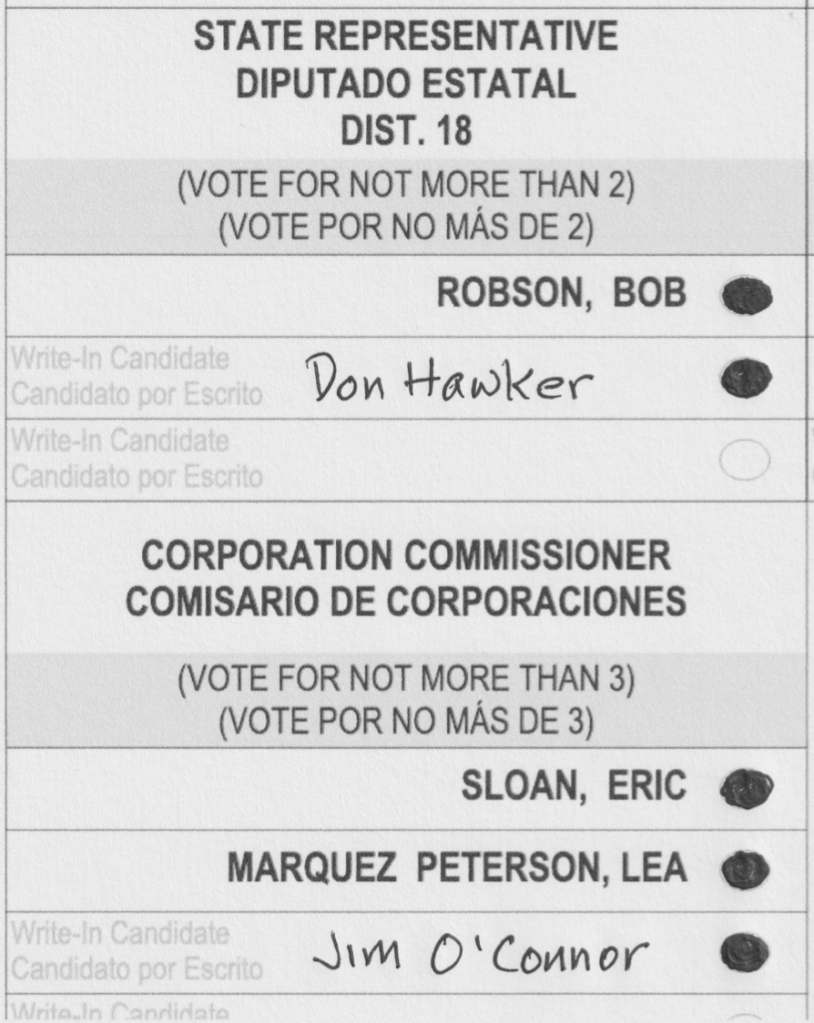
    Arizona Clean Elections (website here) is intended to reduce the influence of special interests on elections. To illustrate how it works, I will use the example of the Arizona Corporation Commission race. Three Republicans, Lea Márquez Peterson, Jim O’Connor, and Eric Sloan, have decided to run as team funded by Clean Elections. To qualify, each of them must get 1,800 individuals to donate $5 each by July 28. We learned on July 15 that they succeeded. The state now keeps the $9,000 and gives them each $174,024, the amount Clean Elections thinks is sufficient to run a general election state-wide in 2020. In return, the candidates agree to limit their private fund-raising to $29,000 ($170 limit per donor), also by July 28.

    To donate, (Don Hawker still needs your support) go to the Arizona Secretary of State: https://apps.azsos.gov/apps/election/eps/qc/ You will be asked to authenticate yourself with your driving license or your voter ID. You will be charged a processing fee of 46 cents. The Secretary of State does not help collect private donations. To make a $170 private donation, you must pay the candidate directly, here.

     
  • Unknown's avatar

    LMHudson 9:13 am on May 29, 2020 Permalink | Reply  

    The importance of a write-in vote in the Arizona Corporation Commission primary 

    Proposition 127, which would have amended the Constitution to require electricity providers to generate at least 50% of their sales from renewal energy, was defeated in November 2018 1,580,101 to 723,138. In the same election, 1,076,800 voters picked Sandra Kennedy, a supporter of Proposition 127, to serve on the Arizona Corporation Commission (ACC).

    The activists behind Prop 127 may believe the easiest route for them to control Arizona’s utilities is via the ACC. There are five commissioners. Three seats are open in November, all now held by Republicans. There were many Republican candidates. All but two, Lea Márquez Peterson and Eric Sloan, were knocked off the ballot by challenges to their signatures. Candidates for the ACC in 2020 were asked to collect 6,663 signatures. Signature challenges are common. Candidates needing 6,663 will normally seek to collect 10,000 or more to provide a margin for error, however the corona virus lockdown intervened in early March, catching four Republican candidates with only about 7,000 signatures each, and the opposition pounced.

    Jim O’Connor can get his name on the November ballot if we write it in in the August primary ballot. He needs 6,663 write-in votes, the same number as the signatures required.

    The Arizona Republican Assembly (AZRA) has endorsed Eric Sloan but not Lea Márquez because Márquez is more sympathetic to renewable energy. Márquez was appointed to the commission by Governor Ducey in 2019. If O’Connor’s write-in bid fails, Democrats will win one seat by default and Márquez may be the swing vote on the commission. AZRA does not endorse write in candidates.

     
  • Unknown's avatar

    LMHudson 10:49 am on May 27, 2020 Permalink | Reply  

    Menu 

    Please contact us on contact@southtempecivics.com if you wish to contribute

    General Election Nov 4, 2025

    example ballot (filled out as I plan to vote)

    Maricopa County Special Health Care District (Valleywise) Proposition 409

    Kyrene ESD No. 28 Budget Override Continuation

    General Election Nov 5, 2024

    example ballot page 1 (filled out as I plan to vote)

    example ballot page 2 (filled out as I plan to vote)

    example ballot page 3 (filled out as I plan to vote)

    example ballot page 4 (filled out as I plan to vote)

    State Senator — District 12

    State Representative — District 12

    City of Tempe Questions 1-3

    Judges of the Superior Court

    Ballot Measures

    Why vote?

    How to vote

    One reason the Legislature needs to go

    Why hand counting is a good thing

    Clean Elections

    Primary Election July 30, 2024

    golden ticket (my recommendations)

    example ballot (filled out as I plan to vote)

    U.S. Senator

    U.S. Representative in Congress – District No. 4

    Corporation Commissioner

    Maricopa County Recorder

    Maricopa County Superintendent of Schools

    SRP Regular Election April 2, 2024 — Division 8

    example ballot

    Presidential Preference Election March 19, 2024

    Why have this election? Why bother to vote?

    City of Tempe Election March 12, 2024

    example ballot

    An argument for Hugo Tapia

    City Council and Mayor

    Proposition 478

    City of Tempe Election May 16, 2023

    City of Tempe Propositions 301, 302, and 303

    General Election Nov 8, 2022

    example ballot

    Some ideas on voting

    Central AZ Water Conserv Dist

    Maricopa County Community College District At-Large

    Tempe Union No. 213 Governing Board Member

    Tempe Union No. 213 Questions 1,2, and 3

    Kyrene Elem No. 28 School Governing Board Member

    Justices and Judges

    Propositions

    Primary Election Aug 2, 2022

    A sample ballot

    Some ideas on how to vote

    Another view…

    Some things ordinary citizens can do in between elections

    Become a Poll Worker/Observer

    Democrats get disproportionate share of Maricopa County temporary poll-worker jobs

    Vote only on Election Day, even with an absentee ballot

    Write to our legislators using email

    Use the Request to Speak (RTS) system to comment on individual bills

    Freedom of Information Act (FOIA) requests

    Recall

    SRP Regular Election April 5, 2022 District 8

    A Post-Mortem

    A sample ballot for the Power District

    A sample ballot for the User’s Association

    Some ideas on how to vote

    Tempe City Council Election March 8, 2022

    Some suggestions

    A sample ballot

    Kyrene Special District Election November 2, 2021

    Kyrene ESD No. 28

    Notes on Kyrene 6-8 curriculum

    Our November 2020 ballot

    Cheatsheet for the South Tempe ballot

    Cheatsheet for the Chandler ballot

    How to return a mail ballot

    Tactical Voting

    Voting for the Lesser of Two Evils

    An argument for not voting in the Board of Supervisors

    Maricopa County Special Health Care District

    Proposition 449

    Tempe Union High School District

    Chandler Unified School District

    Kyrene Elementary School District

    City of Tempe Questions 1-5

    Maricopa County Community College District At-Large

    Maricopa County Community College District 1

    City of Chandler Question 1

    Justices of the Supreme Court

    Judges of the Court of Appeals, Division 1

    Judges of the Superior Court

    An argument for voting against all ballot initiatives

    An argument for voting ‘No’ on Prop 207

    An argument for voting ‘No’ on Prop 208

    A further argument for voting ‘No’ on Prop 208

    August 2020 primary

    Guide to the August 2020 Republican Primary

    The importance of a write-in vote in the Arizona Corporation Commission primary 

    Clean Elections 

    An Argument for voting for Eddie Cook for Assessor and for John Allen as Treasurer

    Arizona Tax Credit and school choice

    Support school choice at no cost to you. Use the Arizona Tax Credit. 

    Corporations, too, can use the Arizona Tax Credit to fund private schools at no cost to them

    SRP

    The importance of voting in SRP elections

    SRP Board election 7 April, 2020 

    How to vote by mail in the April 7 2020 SRP election 

    Tempe zoning

    Tempe claims “federal case law” prevents it from enforcing its zoning laws. 

    GPLET forum January 13, 2020 

    Short-term rental meeting Tuesday September 16, 2019 

    Airbnb is coming to your neighborhood 

    Municipal courts

    8 studies in Municipal Courts 

    Tempe election March 2020

    An argument for voting in the Tempe municipal election 

    All Tempe candidates’ forum January 15, 2020 

    Mayor Candidates’ Forum December 13 

    City Council Candidates’ Forum December 13 

    A proposal for voting in the March 2020 Tempe election: Don’t vote 

     
    • Kirstyn Goodman's avatar

      Kirstyn Goodman 12:02 pm on October 12, 2020 Permalink | Reply

      Hello,

      This is such a helpful resource. Do you know if there is anything like this for Phoenix? I am having a hard time voting for some of the Phoenix specific questions and would love some input.

      Like

      • LMHudson's avatar

        LMHudson 12:52 pm on October 12, 2020 Permalink | Reply

        Thanks for your kind words. I will keep my eyes peeled and link to it if I see it.

        Like

    • azfamilylawtips's avatar

      azfamilylawtips 2:22 am on October 23, 2020 Permalink | Reply

      This is invaluable, and I so very much appreciate this resource. I also liked the “lady’s” deleted tweets… can’t spell her name offhand, so I’ll be over-generous and refer to her generically as a lady. I guess woman with the injured middle finger is a better appellation. Terrible that she can’t bend it after the accident. But it still works to delete tweets and cya. 😉 Thanks for all your hard work! Hoping 11/3 is a WIN for the country, AZ and South Tempe!

      Like

    • azfamilylawtips's avatar

      azfamilylawtips 4:14 pm on October 23, 2020 Permalink | Reply

      Hey, AZ! #WalkAway is bringing some PATRIOT LOVE to the Valley of the Sun! Join us in PHOENIX this Sunday! Let’s RESCUE AMERICA together! Info or register: give.walkawayfoundation.org/event/walkaway-rally-phoenix-az/e296887 Dems walking away from Democratic party & voting for Trump!

      Like

  • Unknown's avatar

    LMHudson 5:57 pm on May 22, 2020 Permalink | Reply  

    Guide to the August 2020 Republican Primary 

    Six contested races and two write-ins:

    1. US Senate: Martha McSally v Daniel McCarthy
    2. US Congress: Dave Giles v Sam Huang v Nicholas Tutora
    3. Arizona Corporation Commission
    4. Arizona House
    5. Maricopa County Assessor: Eddie Cook v Rodney Glassman
    6. Maricopa County Recorder: Stephen Richer v Clair Van Steenwyk
    7. Maricopa County Sheriff: Joe Arpaio v Mike Crawford v Jerry Sheridan
    8. Maricopa County Treasurer: John Allen v Royce Flora
    1. US Senate: Martha McSally v Daniel McCarthy. McSally’s website. McCarthy’s website. The Arizona Free Enterprise Club (AZFEC) has endorsed McSally, here. The Arizona Republican Assembly (AZRA) has endorsed McCarthy, here. The Tea Party Phoenix Metro (TPPM) has also endorsed McCarthy, here.

    2. US Congress: Dave Giles v Sam Huang v Nicholas Tutora. Giles’s website. Huang’s website. Tutora’s website. The TPPM have endorsed Tutora.

    3. Arizona Corporation Commission. Three seats are open in November and there will be two Republicans on the ballot, so there is no primary contest. If we wish the Republicans to retain a voting majority on the ACC, we need to vote in the primary for the two candidates listed, Lea Márquez Peterson and Eric Sloan, and — this is crucial — write in Jim O’Connor, and remember to fill in the circle so the ballot reader knows there is a vote there.

    More information on this race is here. These three Republicans have decided to run as a team, using Clean Elections for funding.

    4. Arizona House: Don Hawker needs both your write-in vote and your $5 Clean Elections contribution. (Some early letters went out when we thought Dan Schultz was going to be the write-in candidate. Dan changed his mind. Sorry for the confusion.)

    5. Maricopa County Assessor: Eddie Cook v Rodney Glassman Cook’s website. Glassman’s website. When the incumbent Assessor resigned, Cook was appointed to serve out his term. The Maricopa County Board of Supervisors solicited 11 applications, of which Glassman’s was one, and chose Cook unanimously as interim Assessor. Further detail here.

    6. Maricopa County Recorder: Stephen Richer v Clair Van Steenwyk Richer’s website. Steenwyk’s website. AZFEC, AZRA, and the TPPM have all endorsed Richer.

    7. Maricopa County Sheriff: Joe Arpaio v Mike Crawford v Jerry Sheridan Arpaio’s website. Crawford’s website. Sheridan’s website. AZRA and the TPPM have endorsed Sheridan.

    8. Maricopa County Treasurer: John Allen v Royce Flora Allen’s website. Flora’s website.

    Special bonus for Waggoner Precinct: We are lucky to have 18 volunteers for precinct committeeman, but state law limits us to 12 slots. Work and family commitments change constantly. As of this writing there are 12 best able to serve the precinct. Please vote for the following: (The order is the result of a random drawing by the county recorder’s office.)

    1. Moakler, John Robert
    2. Benedict, Anthony J.
    3. Duffell, Robert Victor
    4. Stapley, Patricia Jo
    5. Sherbeck,Jonathan Adair
    6. Hudson, Lawrence Marion
    7. Newman, Toni Kay
    8. Andersen, Roger William
    9. Chamberlin, Robert Henry
    10. Baxter, William Clayton
    11. Hattendorf, Kimber L.
    12. Sobczak, Margaret M.

     
    • Elizabeth Lambert's avatar

      Elizabeth Lambert 1:49 pm on August 4, 2020 Permalink | Reply

      I have just discovered your blog; thank you for writing this and providing so many details. It can be difficult to find information about local elections and candidates without attending every meeting and town hall. As a mother of six young children I have found your blog extremely helpful.

      Like

  • Unknown's avatar

    LMHudson 10:27 am on May 19, 2020 Permalink | Reply  

    The importance of voting in SRP elections 

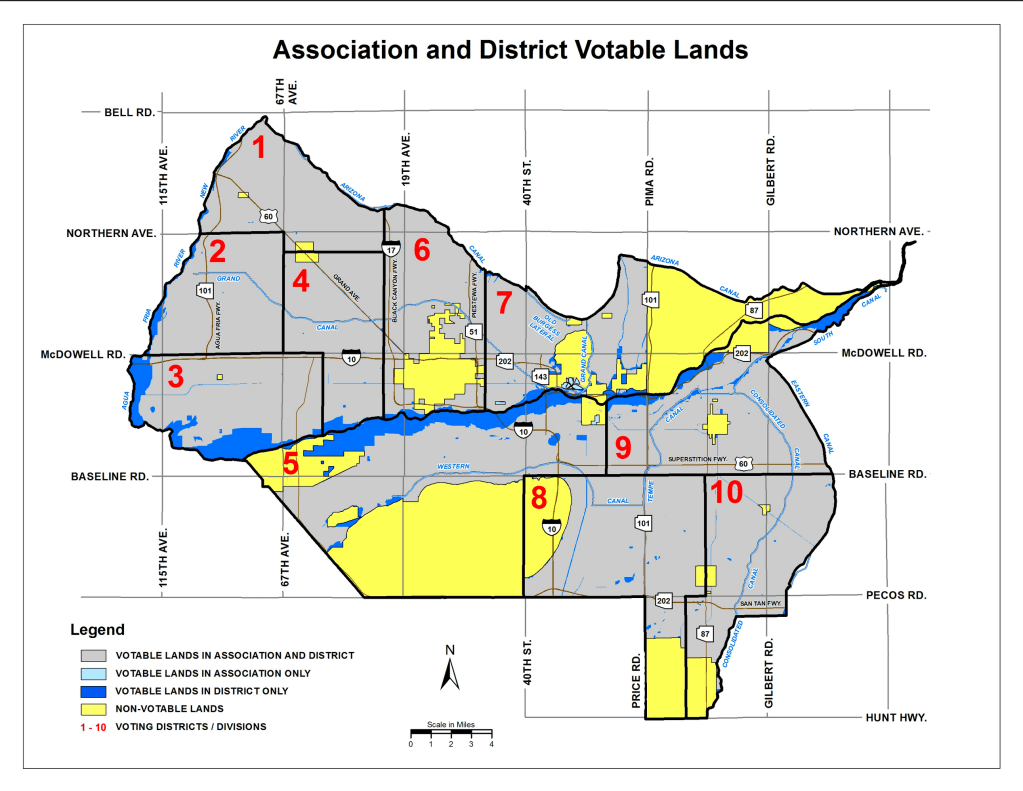
    In April, environmental activists won the two of the four at-large seats. ‘At-large’ means they represent every property-owning household in the SRP service area (see the map below), of which there are about 645,000. For Seats #11 and #13 respectively, 5,549 and 5,360 votes were cast, so less than 1% of the electorate even voted. Anda McAfee won with a mere plurality in Seat #11 because her two opponents split the remaining votes. She and her colleague Nick Brown nevertheless cast full votes on SRP’s 14-member board.

    The districts vote by acreage. Our district, 8, had no election this cycle. District 9 (north Tempe and Mesa) has about 30,000 acres coded gray and saw 458.41 votes casts, about 1.5% of the electorate.

    The SRP tries to encourage voting by enclosing flyers in the utility bills that get delivered by mail. If you receive your utility bill electronically, there is no reminder. If your part of the map is coded gray and you own your property, you can probably vote. Please see the neighboring post (How to vote by mail in the April 7 2020 SRP election) for instructions on registering.

     
  • Unknown's avatar

    LMHudson 5:17 pm on May 1, 2020 Permalink | Reply  

    Corporations, too, can use the Arizona Tax Credit to fund private schools at no cost to them 

    In my post below (dated August 28, 2019), I show how individual taxpayers can use the Arizona Tax Credit to fund private and charter schools at no cost to them. Getting individuals to use the program is still an urgent priority because the state-wide takeup is so low. I say “at no cost” because the law permits us to divert money from our Arizona income tax liability to schools and other charities. If you give $100, your tax bill is reduced by $100. The Tax Credit is the best tool we have to undermine the monopoly over education now held by the Arizona Education Association (AEA).

    Individual giving via the Credit is limited by statute at the level of the individual. For example, a couple filing jointly in 2019 could give up to $2,269. Corporate giving is limited in the aggregate. It is presently capped by the Legislature at just over $100 million. The program is popular: the cap is reached so quickly that there is a race to qualify at the beginning of July, when the window opens. Even if you fail to qualify, your attempt builds pressure on the Legislature to raise the cap.

    You must give through a School Tuition Organization (STO), of which there are many (link here), with varying specialties and capabilities. I use the Arizona School Choice Trust (http://www.asct.org) because I know the staff and because they can direct my gift to local private schools, such as Desert Gardens Montessori and St Timothy’s Catholic School.

    Giving via STOs is intended to benefit students from lower-income families. Eligibility is tied to the same rules that govern the nationwide school lunch program. For example, a family of four can have annual income of as much as $48,000, and get a 90% scholarship. That family can have income as high as $89,000 and get a 50% scholarship.

    The AEA claim that school choice programs like the Tax Credit drain money from the district school system. They are correct in the following sense: both federal and state aid to education follow the student. If the student leaves a district school (for a private or a charter school) that district loses the aid associated with that student, and they no longer have the marginal costs, but they are stuck with the physical plant and the teachers’ pensions. The AEA may also reasonably fear that voters in a district with active school choice may be reluctant to approve school bond issues and overrides. This subject is worth a separate post.

     
  • Unknown's avatar

    LMHudson 4:15 pm on March 18, 2020 Permalink | Reply  

    SRP Board election 7 April, 2020 

    We are asked to vote in this election because of an artifact in the title to our property. The organizers who brought us Proposition 127 in 2018 are hoping, gradually, to populate the SRP board with environmental activists, who will bring us blackouts and high energy bills, as in California. They have branded themselves the SRPCleanenergy party. The more business-like group call themselves the Keeptheflow party.

    If you have a clean choice between an SRPCleanenergy candidate and a Keeptheflow candidate, I recommend voting for the latter. In the At-large Seat 13 race, I will vote for Wendy Marshall.

    In the race for At-large Seat 11, in addition to the SRPCleanenergy and the Keeptheflow candidates, there is a third candidate named Greg Patterson. In 2018, he ran for the Arizona House LD18 as a Republican and has no program that I can find, apart from the slogan “More Solar.” He solicited support for the House race with no program other than a promise to serve. His presence in the SRP race probably splits the conservative vote and makes it more likely the environmental activist (Anda McAfee) will win. I will vote for Christopher Dobson.

    Wendy Marshall’s website is here:

    Christopher Dobson’s website is here:

    Anda McAfee’s website is here:

    Nick Brown’s website is here:

    Greg Patterson’s facebook page is here:

     
  • Unknown's avatar

    LMHudson 2:56 pm on February 22, 2020 Permalink | Reply  

    An argument for voting in the Tempe municipal election 

    Bill Baxter writes: I’m going to vote for Corey Woods for mayor for two reasons:

    1. Police and fire pensions are a huge fiscal threat to Tempe. They are skyrocketing and out of control. The city pays $.70 to the pension fund for each $1 paid for current salaries. Outrageous. That’s why those unions support Mitchell, who refuses to address any solution in what is clearly in my view corruption in the most clear sense. Look at the money they have spent on the signs on every corner. Money they will get back from citizens many times over. Mitchell is dug in on this to protect his public office. It’s time we get somebody in there who will address the problem, and Corey goes in obviously with as close to zero police/fire political debt as one can get. [Editorial: public unions are anathema to the republic and should be illegal, as they were for many decades. There is an intrinsic conflict of interest in the concept of a public union. But since they are not, maybe we can at least avoid them bankrupting the city, as they will many cities, including Tempe if this doesn’t get fixed. And BTW, police/fire is the biggest gravy train in the country. They talk about them as if it is hard to get somebody to do the job, but there are hundreds of applicants for every opening, and why not ? A better gravy train cannot be found.]
    2. It is simply time to throw Mitchell out of office. He has grown up sheltered by his political connections. It is well past time for a change.

    I know some of you will grouse at me how Corey is no better, but I’m going to throw the die on this one.

    Regarding the city council, Navarro and Keating have shown nothing to make me inclined to vote for them and they are also close with the unions. Navarro is a Phoenix fireman, after all. I’m going to vote only for Garlid, and while I am not certain about that vote either, at this time there do not appear to be close ties to police and fire unions.

    In my view, a Republican has no chance for a mayor or council job in Tempe until the elections move to coincide with November general elections, per new state law. It is unclear to me whether that will be 2022 or 2024.

     
  • Unknown's avatar

    LMHudson 12:22 pm on February 15, 2020 Permalink | Reply  

    All Tempe candidates’ forum January 15, 2020 

    Youtube link is here. One hour 25 minutes.

    This forum was sponsored by the Tempe Interfaith Fellowship. You can find them on facebook. Two leftist ministers ask 10 softball questions. Randy Keating is absent, so there are 6 panelists. Eighty-five minutes divided by 60 yields response times of a little over a minute each. There is almost no clash at all. Casey Clowes prefers the subject of climate change, and when she is served with that question (48:35) she has such ready answers that the other candidates fall over each other agreeing with her. At the end (1:20:10), Mark Mitchell admits that the Arizona Legislature might not agree that the city has any role in addressing these issues.

    1. What is your #1 priority (4:00)

    • Mitchell: quality of life.
    • Woods (5:00): affordable housing. He is for it.
    • Garlid (6:15): bring people together in forums like this.
    • Navarro (7:20): homelessness and addiction. He is against it.
    • Norman (9:30): homelessness and affordable housing. He wants to tax new development.
    • Clowes (10:30): sustainability.

    2. What will you do to provide affordable housing? (11:30)

    • Garlid (14:50): introduced I Help (link here) to her church.
    • Navarro (15:50): get homeless out of parks, off streets.
    • Norman (17:30): trying to help people who can be helped, such as local high school students who are couch-surfing.
    • Clowes (19:05): we should invest in I Help, affordable housing.
    • Mitchell (20:10): wants to improve quality of life for all residents, especially the homeless. Goal of 16,500 affordable units.

    3. How will you work with the faith community? (22:20)

    • Garlid (22:50): it’s a good idea.
    • Navarro (24:00): 142 churches in Tempe. City should be a “router.”
    • Norman (26:05): Can we park a trailer and get electricity?
    • Clowes (26:50): wary of breaching wall between church and state.
    • Mitchell (27:40): cites work of Agency Review. Assure no effort is duplicated.
    • Woods (29:15): only rotating shelter in Tempe is faith-based.

    4. How will you protect LGBTQ people? (30:55)

    • Navarro (31:20): ASU, parks, and downtown are all assets.
    • Norman (32:45): Everyone should talk.
    • Clowes (34:05): LGBQT people need state-wide protection. Require sensitivity training. Ban conversion therapy.
    • Mitchell (35:15): cites achievements, such as 100% score from Human Rights Coalition (HRC).
    • Woods (37:05): claims credit for rise in HRC score from 72. Claims people can be fired in Arizona for having a picture of a non-traditional partner on their desk. Many homeless are LGBTQ.
    • Garlid (39:25): build on existing non-discrimination ordinance.

    5. How can you improve parking in downtown for faith-based groups, such as the Mosque? (40:15)

    • Norman (41:25): “Good luck with that!”
    • Clowes (42:10): invest in public transit, bicycle infrastructure. Can’t single out faith-based groups.
    • Mitchell (42:40): cites achievements, such as free Orbit, Park & Ride.
    • Woods (44:20): cites Tempe employee Adam Jones as parking expert.
    • Garlid (45:25): more, better communication.
    • Navarro (46:20): Tempe is the best at solving this kind of problem.

    6. What can you do about Tempe’s carbon footprint? (48:35)

    • Clowes (49:00): invest in Orbit, plant trees for shade, build more, better bus shelters, improve bicycle infrastructure, “traffic demand management,” encourage employers to allow off-peak commute schedules, dis-incentivize private cars.
    • Mitchell (50:30): goal of being carbon neutral by 2050. Multi-modal transport. Dedicated revenue stream. Spending $3m to alleviate congestion at Rural & University. Free youth bus passes.
    • Woods (52:40): agree with Clowes. Valley-wide light rail. Make it go where people actually want to go. Telecommutation.
    • Garlid (54:30): ditto to Clowes. Especially likes tree canopy.
    • Navarro (55:35): 200,000-300,000 commuters inbound every day.
    • Norman (57:40): ditto to Clowes.

    7. How will you help public education? (58:15)

    • Mitchell (58:40): neighborhoods, parks, schools very important. Cites achievements such as Tempe’s pre-K. Most important considerations for prospective residents are quality of K-12 and public safety.
    • Woods (1:00:45): schools are lifeblood of community.
    • Garlid (1:02:30): cites Beans & Rice program to provide snacks at school breaks.
    • Navarro (1:04:00): have two coordinators on Tempe payroll. Maybe need more. Cites Kid Zone for after-school care. Hopes Tempe pre-K will have a waiting list.
    • Norman (1:06:20): trying to get homeless kids to graduate.
    • Clowes (1:07:20): likes Tempe pre-K. Tempe also funds mental health counselors for the school districts.

    8. Feminine hygiene products are no longer available in city bathrooms. Can they be restored? (1:08:20)

    • Woods (1:09:10): as a man, he cannot represent women. Needs help.
    • Garlid (1:10:30): cites a charity that may provide this.
    • Navarro (1:11:25): communicate and coordinate. Set priorities.
    • Norman (1:12:45): doesn’t spend time in womens’ bathrooms.
    • Clowes (1:13:30): this is a public health issue.
    • Mitchell (1:14:05): admits he did not know about this.

    9. What keeps you awake at night? What are your hopes and fears? (1:15:05)

    • Garlid (1:15:30): have I served others adequately?
    • Navarro (1:16:40): did I do right?
    • Norman (1:18:50): combating homelessness.
    • Clowes (1:19:30): the climate crisis.
    • Mitchell (1:20:10): fear of preemption by the Arizona Legislature.
    • Woods (1:21:30): seeks to wipe the slate clean every day.

    10. Addressed only to the mayoral candidates. Are you willing to meet with the faith-based community at least once a year? (1:22:45)

    • Mitchell (1:23:25): every month.
    • Woods (1:23:50): every week.

     
  • Unknown's avatar

    LMHudson 11:27 am on February 14, 2020 Permalink | Reply  

    How to vote by mail in the April 7 2020 SRP election 

    We are asked to vote too often, on questions that are hard to understand and for candidates who are hard to research. Many people respond by tuning out, which gives activists an opportunity to control more and more of our lives. The SRP is in play, because they make decisions about energy use and sustainability.

    South Tempe is in District 8. There is an election scheduled for April 7. If you want to vote by mail, the deadline for applying for an early ballot is Friday, March 27. You can vote in person starting March 11 at the SRP building 1500 N. Mill Ave. You can ask for an early ballot and learn about this election here.

     
  • Unknown's avatar

    LMHudson 4:17 pm on February 8, 2020 Permalink | Reply  

    Tempe claims “federal case law” prevents it from enforcing its zoning laws. 

    In September, at the Pyle House, I asked Lauren Kuby why the city does not use its consanguinity ordinance to stop Holbrook House (see neighboring posts) from functioning as a rooming house. She replied “federal case law” and instructed her chief of staff, Elizabeth Higgins, to explain that to me. I received Ms Higgins’s answer on February 7, reproduced here.

    Ms Higgins cites the Fair Housing Act and three Supreme Court decisions plus two Arizona laws to make the case that Tempe’s consanguinity law cannot be enforced. Here are her citations, links to the texts of the statutes or decisions, with brief comments by me.

    The Fair Housing Act (FHA) is Title VIII of the Civil Rights Act (1968, as amended 1988), statute linked here. The FHA sought to prevent discrimination in real estate and housing due to “race, color, religion, sex, familial status, or national origin.” In 1988, Congress amended the FHA to add “handicapped” to these protected classes and to prevent discrimination against families with children under 18. It carves out an exemption for everyone who is not in the real estate business, such as individuals selling or renting to other individuals. It exempts from liability any “reasonable” restriction on maximum occupancy. It is unclear how Holbrook House comes under the FHA. The renting is a private transaction between individuals and neither the landlord nor the tenants belong to a protected class.

    Village of Belle Terre v Boraas (1974), SCOTUS decision (including dissent) linked here. A house in Belle Terre, Long Island was rented to 6 unrelated students attending a local college. Belle Terre sued the occupants under an ordinance which outlawed more than two unrelated persons living together. The case eventually reached the Supreme Court which upheld Belle Terre. Even writing in dissent, Thurgood Marshall wrote that zoning “may indeed be the most essential function performed by local government, for it is one of the primary means by which we protect that sometimes difficult to define concept of quality of life.”

    Moore v City of East Cleveland (1977), SCOTUS decision linked here. East Cleveland had an ordinance which defined “family” in such a way that it barred a grandmother from living with her son and two grandsons. The Supreme Court ruled against East Cleveland.

    City of Edmunds v Oxford House (1995), SCOTUS decision (including dissent) linked here. Oxford House, a charity, housed 12 recovering drug addicts in a house in a single family neighborhood in Edmunds, WA. The city of Edmunds sued Oxford House under an ordinance which set a limit of 5 unrelated persons in a household. Oxford House defended itself with the FHA, claiming its residents were handicapped and therefore protected. The city of Edmunds responded by citing 3607(b)(1): “Nothing in this title limits the applicability of any reasonable local, State, or Federal restrictions regarding the maximum number of occupants permitted to occupy a dwelling.” Ruth Ginsburg, writing for the majority, argued that, since the FHA was intended to end discrimination, exceptions to the Act should be very narrowly read. Since Edmunds’s occupancy limit of 5 contained an exception for actual families, it was not simply an occupancy limit and therefore not entitled to exemption from the FHA. Clarence Thomas (joined by Antonin Scalia) wrote in dissent (1) that statutes don’t have intentions or spirits, (2) that there is only the language of the statute, and (3) that the FHA statute exempts from liability cities using reasonable maximum occupancy zoning rules. If a similar case were to come to the Supreme Court now, the city would likely be upheld.

    Ms Higgins goes on to cite Article II of the Arizona Constitution and Prop 207 (now ARS Article 2.1) as examples of state laws preventing “takings.” She seems to believe that, if Tempe were to enforce its zoning laws, Juan Pulido, the owner of Holbrook House, would be able to claim to be the victim of such a taking; however, the true victims of a taking are Pulido’s neighbors, whose house values have all declined. Section 12-1134 of Article 2.1 specifically does not require compensation by the government if the taking is “for the protection of the public’s health and safety,” that is, for zoning purposes.

    Ms Higgins’s citations actually make the case for local zoning, including consanguinity laws. It remains unclear why the City of Tempe claims to be powerless in the face of a rooming house in a single family neighborhood.

     
c
Compose new post
j
Next post/Next comment
k
Previous post/Previous comment
r
Reply
e
Edit
o
Show/Hide comments
t
Go to top
l
Go to login
h
Show/Hide help
shift + esc
Cancel